Affiliate disclosure: This article contains affiliate links. If you sign up through one of these links, we receive a commission at no extra cost to you.
AI is being used for almost everything at the moment, so it was only a matter of time before it became a big part of sports betting too.
You will now see websites offering AI betting tips, prediction models claiming to find profitable selections. Plenty of people are asking tools like ChatGPT which team is going to win or how many goals will there be, but can AI predict sports betting results?
There is some genuine value in using AI for betting research, but there is also a lot of hype around what it can actually do.
AI can process huge amounts of information, spot patterns and help put probabilities on different outcomes. That can be useful, but sport is still unpredictable. A model can rate one team as the most likely winner and the bet can still lose.
That’s also where betting gets a little more complicated. Picking the most likely winner is one thing; deciding whether the odds are actually worth taking is another.
Can AI Really Predict Sports Betting Results?
AI can certainly make predictions about sporting events, but I’d think of them more as probability estimates than forecasts of exactly what is going to happen.
A model might analyse thousands of previous matches and decide that one football team has a 62% chance of winning. That can be useful information, but it still means the model expects that team to fail to win a significant proportion of the time.
Sport contains too many unpredictable variables for any system to know exactly what is going to happen.
A red card, an injury, a missed penalty, a tactical change or even a lucky deflection can completely change the outcome of a match.
AI can estimate how likely different outcomes are, but there will always be an element of uncertainty.
That is a much more realistic way to think about AI betting predictions.
What Does “AI Betting Prediction” Actually Mean?
The term “AI” gets used very loosely in betting.
Two services can both claim to offer AI predictions while using completely different methods behind the scenes.
Some may genuinely use machine-learning models trained on large sports datasets. Others may use fairly traditional statistical models and describe them as AI because it sounds more impressive.
There is also a big difference between those systems and general AI tools such as ChatGPT.
General AI Tools
Tools such as ChatGPT are primarily designed to understand and generate information.
They can be useful for researching a match, explaining statistics, comparing information and helping you think through a betting decision.
What they are not, by default, is a purpose-built sports prediction model constantly trained on live betting data.
If you ask a general AI tool, “Who will win Arsenal vs Liverpool?”, the answer may sound convincing, but that confidence should not be mistaken for a proven betting edge.
The quality of the answer will depend heavily on the information available to the model and the way the question is asked.
Predictive Models
A predictive model is usually built for a much narrower purpose.
A football model might use recent results, expected goals, home and away performance, player availability, shots, chances created and even market odds to estimate the probability of different outcomes.
More sophisticated models can learn which variables have historically been most useful and how much weight to give them.
That can make them powerful research tools, but they are still only as good as the data and assumptions behind them.
What Can AI Be Useful for in Sports Betting?
One of AI’s biggest advantages is the amount of information it can process.
A human bettor might reasonably study recent results, expected goals, team news and a handful of other statistics before making a decision. A purpose-built model can potentially analyse far more variables across thousands of previous matches.
That makes AI particularly useful for finding relationships that would be difficult to spot manually. A model could examine whether certain statistics have historically been predictive, how teams perform under particular conditions or which combinations of factors tend to matter most.
It can also apply the same process consistently across every event. There is no temptation to give extra weight to a team because of a recent result or because you happen to have a strong opinion about them.
None of that guarantees a profitable result, but it does explain why AI and machine learning can be useful for analysing sports data.
What AI Cannot Do Reliably
AI is only as useful as the information it is working with.
With general AI tools in particular, an answer can sound confident even when it is based on incomplete or outdated information, so current details such as injuries, team news or market prices still need to be checked.
AI also cannot remove variance. A model could identify a genuinely good betting opportunity and still lose that particular bet, or go through a run of losers without the underlying approach necessarily being wrong.
And, as we’ll come to next, correctly identifying the most likely winner still does not tell you whether the odds represent a good bet.
Why Predicting the Winner Is Not the Same as Finding Value
This is where AI predictions need to be separated from betting decisions.
Imagine an AI model calculates that Manchester City have a 60% chance of winning a match.
That would make them the most likely winner.
But whether they are worth betting on depends on the odds.
A 60% probability corresponds to fair decimal odds of around:
1 ÷ 0.60 = 1.67
If the bookmaker is offering 1.40, the price may be too short even if the prediction itself is accurate.
If the bookmaker is offering 1.90, the same prediction could represent value.
That is why simply asking an AI to pick the winner is rarely enough.
The useful question is whether the probability estimated by the model is different enough from the probability implied by the market price.
I have covered that idea in more detail in the guide to value betting.
Can AI Beat the Bookmakers?
There is no reason an AI-based model couldn’t find profitable betting opportunities, but using AI does not somehow bypass the usual difficulties involved in beating the market.
The challenge is the same one faced by any successful bettor or tipster: finding occasions where your assessment of an outcome is more accurate than the probability reflected in the odds.
AI may have some advantages here. A model can analyse far more data than a person could realistically work through manually, and it can apply the same process to every match without being influenced by emotion or personal bias.
But those advantages do not automatically create an edge.
Bookmakers use sophisticated models themselves, and the odds are also influenced by money coming into the market from thousands of other bettors. By the time a major sporting event starts, a huge amount of information may already be reflected in the price.
That means the interesting question isn’t really whether AI can beat bookmakers. It’s whether a particular AI model can produce probability estimates that are good enough to find value consistently.
The same standard should apply to a human tipster.
The Biggest Problems With AI Betting Predictions
Even a well-built prediction model can go wrong.
Some of the biggest problems are not really about AI at all. They come down to the data, the way the model was tested and whether the historical results are realistic.
Poor or Incomplete Data
A model cannot make good decisions from bad information.
If the historical data contains errors, missing matches or inconsistent statistics, those problems can feed directly into the predictions.
The same applies if important variables are missing.
A football model might look impressive most of the time, but it can still miss something important. If it has no way of accounting for a key striker being ruled out, for example, the prediction may already be working from the wrong picture of the match.
Overfitting
Another problem is when a model becomes too good at explaining what happened in the past. It can end up learning quirks in the historical data that don’t carry over to future matches.
That means a backtest can look fantastic while the model performs much worse once it starts making genuinely new predictions.
This is one reason extremely impressive backtests should always be treated with some caution.
The real test is how the model performs on data it has never seen before.
Data Leakage
Data leakage is a different problem. This is where the test accidentally gives the model information it would never have had when the bet was actually placed.
Imagine a backtest includes a statistic that was only known after kick-off. The model may suddenly look much more accurate, but that result would be impossible to reproduce in real betting.
Changing Conditions
Sport does not stand still.
Managers change, players move clubs, tactics develop and competitions evolve, and a pattern that worked well five years ago may not be nearly as useful today.
Models therefore need to adapt rather than assume that relationships found in historical data will remain the same forever.
How Could You Use AI for Betting Research?
For most bettors, I think AI is more useful as a research tool than as something you ask to pick a winner.
You could, for example, give it recent data for both teams and ask it to compare their attacking and defensive numbers. It might point out a difference you had not noticed, or give you a few areas worth digging into before you make a decision.
You would still need to decide whether any of that is actually relevant to the market you are looking at. I think that is where AI is most useful: helping you get through the research faster without taking the final decision away from you.
Another useful area is analysing your own betting.
If you have a spreadsheet containing a few hundred bets, AI can help you look for patterns in the results. Perhaps you are performing well on football totals markets but poorly on match odds, or your results are noticeably better at certain price ranges. It can help highlight patterns like these that you can then investigate properly.
There are plenty of smaller jobs it can help with too, from explaining an unfamiliar statistic to working out implied probabilities or helping you structure a spreadsheet.
Used this way, AI is doing something much more realistic than attempting to predict the next winner. It is helping you analyse information and make your own betting decisions more efficiently.
Should You Trust AI Betting Tips?
The words “AI powered” do not automatically make a betting service more trustworthy.
If anything, I would judge an AI tipster in exactly the same way as any other betting service.
I would want to know:
- Are the results recorded before the event?
- How many bets are included?
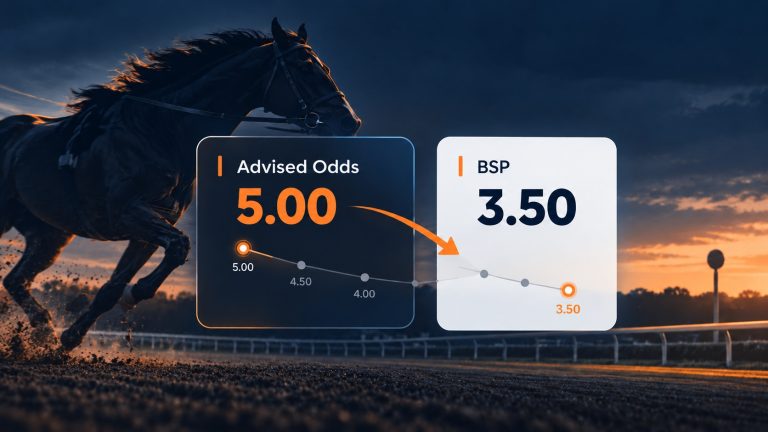
- Are advised odds realistic and available?
- What is the long-term profit and ROI?
- Does the service explain how selections are generated?
- Are poor periods included in the results?
- Does the strategy consistently beat the market price?
A service claiming to use a sophisticated AI model should still be able to provide transparent evidence that the predictions actually work.
The technology behind the tips is interesting, but the results still matter.
This is also why looking beyond headline profit is important when choosing a betting tipster.
AI vs Human Betting Analysis
AI and human bettors have different strengths.
AI is very good at processing large amounts of information consistently.
It does not get bored after analysing fifty matches, and it can apply the same process every time without becoming impatient or emotionally attached to a particular outcome.
Human judgement can still be useful for context that is difficult to capture cleanly in a dataset.
A statistical model may see a team that has won five games in a row, while someone who watched those matches may know the performances were much less convincing than the results suggest. The same applies to things like tactical changes, motivation or the effect of a new manager.
In practice, the most useful approach may be to combine the two.
Use AI to process data and highlight possibilities, then apply human judgement before deciding whether the price actually makes sense.
Final Thoughts
AI has plenty of genuine uses in sports betting, from analysing large datasets to helping bettors research matches and understand their own results.
What matters is how you use it.
A prediction on its own tells you very little about whether a bet is worth placing. You still need to consider the probability behind the prediction, the odds available and whether there is actually any value in the price.
For most bettors, that is probably where AI is most useful: as another tool for improving the research and decision-making process rather than something that simply tells you what will win.