Affiliate disclosure: This article contains affiliate links. If you sign up through one of these links, we receive a commission at no extra cost to you.
Value betting is one of the most important concepts to understand if you want to take sports betting seriously. The idea itself is fairly simple: instead of just trying to pick winners, you are looking for bets where you believe the odds being offered are bigger than they should be.
In other words, you are asking:
“Are these odds giving me a better price than the true probability of the outcome suggests?”
If the answer is yes, you may have found a value bet. In this guide, we’ll look at what value betting means, how bookmaker margins affect the odds and some of the ways value can appear in a betting market.
Value Betting vs Picking Winners
One of the biggest mistakes casual bettors make is focusing only on who they think will win.
Imagine hearing these two conversations in your local bookies.
Punter 1: “City are going to win this game. It doesn’t matter what the odds are. They haven’t lost at home all season and they’ll be well up for it.”
Punter 2: “Forest look too big against City. City have a few important players missing, they’ve had a busy schedule and Forest have had more time to prepare. Forest are 7/1, but I’d make them closer to 5/1.”
The second punter is thinking differently. They already have an idea of what price Forest should be and are comparing that with the odds available.
That is crucial to value betting, because it isn’t about picking winners at any price, but about finding markets where you believe the bookmaker’s odds are wrong.
How Odds and Implied Probability Work
To understand value betting properly, it helps to know how betting odds relate to probability.
With decimal odds, you can work out the implied probability using this formula:
Implied probability = 1 ÷ decimal odds × 100
For example:
- Odds of 2.00 = 50%
- Odds of 1.50 = 66.7%
- Odds of 4.00 = 25%
You can also work the other way around to calculate fair odds.
If you think an outcome has a 50% chance of happening:
1 ÷ 0.50 = 2.00
So 2.00 would be your fair price. If you believe a horse has a 30% chance of winning:
1 ÷ 0.30 = 3.33
If a bookmaker is offering 4.00, the available price is bigger than your estimated fair odds, which is where the potential value comes from.
How Bookmaker Margins Affect the Odds
Bookmaker odds don’t simply reflect the probability of each outcome. There is also a margin built into the market.
Take a tennis match between two evenly matched players.
If both genuinely have a 50% chance of winning, the fair odds would be:
2.00 vs 2.00
But a bookmaker might instead offer:
1.90 vs 1.90
Odds of 1.90 imply a probability of around 52.6%.
Add both players together:
52.6% + 52.6% = 105.2%
Clearly, both players can’t have more than a 50% chance of winning the same two-runner match. The extra percentage represents the bookmaker’s margin.
Another way to think about it is with a fair coin toss. If someone offered you odds of 1.90 on heads, would you take the bet?
You know the true probability is 50%, so the fair odds should be 2.00. Taking 1.90 means accepting a worse price than the probability justifies.
This is why finding a price that looks slightly wrong isn’t always enough. Any edge you think you have needs to be strong enough to overcome the margin already built into the market.
Calculating Fair Odds
Calculating implied probability is easy.
Working out what the true probability should be is much harder.
This is where value betting becomes more difficult in practice. Converting odds into percentages takes seconds. Deciding what percentage you would put on an outcome yourself is another matter entirely.
You might use things such as:
- historical data
- statistical models
- team or player ratings
- recent performances
- injuries and team news
- market comparisons
- your own specialist knowledge
In reality, most serious bettors will use a combination of different information rather than relying on one thing alone. The danger is convincing yourself that you have found value simply because you like a bet.
If you believe a selection has a 10% edge but your probability estimate is wrong, then the value may not really be there. Having your own idea of the fair price, and a sensible reason for arriving at it, is a big part of the process.
What Does Positive Expected Value Mean?
Expected value, often shortened to EV, is a way of looking at what you would expect to happen if you could place the same type of bet repeatedly.
Imagine you believe a bet has a 50% chance of winning and the bookmaker is offering odds of 2.20.
If you placed ten identical £10 bets, you would expect roughly five to win and five to lose. Five winning bets at 2.20 would return £110 in total, while the ten bets would have cost £100, giving you an expected profit of £10.
Of course, real betting doesn’t play out in neat groups of ten bets, but this is the basic idea behind positive expected value. It also explains why one losing bet doesn’t automatically mean it was a bad bet, just as one winner doesn’t automatically mean it was a good one.
How to Find Value Betting Opportunities
Steam Chasing
One example of a value betting strategy is known as steam chasing.
This involves watching for significant price movements at sharper bookmakers, then checking whether other bookmakers have adjusted their own odds yet.
Pinnacle is often used as a reference point because its markets are generally considered to be relatively efficient. If a price shortens there but a UK bookmaker is still offering the old, bigger price, there may be a short window where that price offers value.
Software such as Trademate is designed around this type of approach. It monitors prices across different bookmakers and alerts users to potential value bets when it identifies discrepancies.
The important point isn’t simply that the odds are shortening. The idea is to take the bigger price while it is still available, before the slower bookmaker catches up with the wider market.
Of course, getting a better price doesn’t mean the bet will win. You could consistently beat the eventual market price and still experience losing runs in the short term, which is another reason value betting needs to be judged over a much larger sample of bets.
Shopping Around for Better Odds
Sometimes the simplest way to improve the value of your bets is to make sure you are taking the best available price.
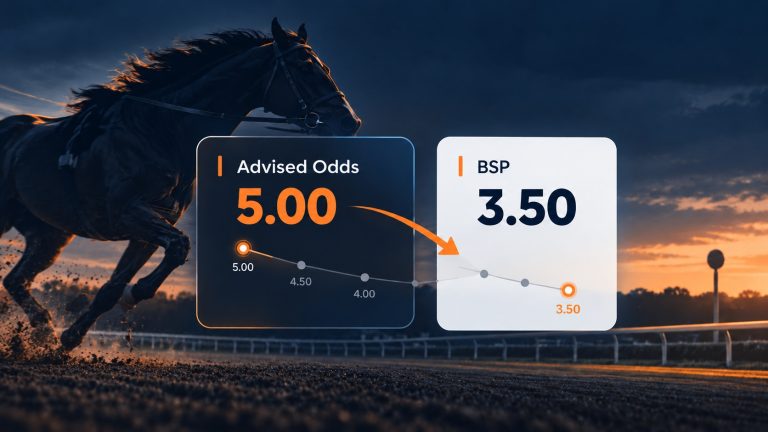
If one bookmaker offers a horse at 5.00 and another offers 6.00, you are being paid considerably more for taking exactly the same risk.
That difference may not seem huge on one bet, but it can make a meaningful difference when repeated over hundreds of bets. It is also one of the reasons odds availability matters so much when following a tipster.
Team News
Betting markets can move quickly when important information becomes available, especially close to kick-off. If a key football player is ruled out shortly before a match, prices may start shifting almost immediately as the market reacts.
That can create an opportunity if you believe a particular market hasn’t adjusted enough yet. The key is not simply spotting the news first, but judging how much it should actually change the probability of the outcome and whether the price still on offer is now too big.
Ante-Post Betting
Value can also appear in long-term markets. Imagine backing a horse at 50/1 several months before a major race, only for that horse to improve, attract plenty of support and shorten to 16/1 by race day.
You have secured a much bigger price than was available later on. That doesn’t prove the original bet was value, because plenty may have changed in the meantime, but consistently beating the eventual market price can be a useful sign that you are making good betting decisions.
Value Bets Still Lose
Finding value does not mean finding guaranteed winners. A perfectly good value bet can still lose, and bigger priced bets may lose far more often than they win.
That is where variance comes into play.
What matters is whether you are consistently making sensible decisions and taking prices that you believe are bigger than the true chance of the outcome.
This is also why sensible staking and bankroll management matter so much, because even a profitable betting approach can experience losing runs and your staking needs to give you enough room to deal with them.
Final Thoughts
Value betting changes the question you ask when looking at a bet.
Instead of simply asking, “Do I think this will win?”, you start asking, “Is the price big enough for the chance I think it has of winning?”
That distinction is what separates finding winners from finding potentially profitable bets.
You won’t get every judgement right and even excellent value bets will lose regularly. But if you can become better at estimating probabilities, consistently take the best prices available and manage your betting bank properly, you put yourself in a much stronger position over the long term.
BETTING SCHOOL
Want to learn more?
Head over to our Betting School for more guides on staking, bankroll management and finding better betting opportunities.