Affiliate disclosure: This article contains affiliate links. If you sign up through one of these links, we receive a commission at no extra cost to you.
When you’re looking at a horse racing tipster’s results, the profit figure is usually the first thing that catches your eye.
The problem is that the headline number doesn’t always tell the full story.
A service might show a strong profit at the advised odds, but those prices may have shortened significantly by the time most followers placed their bets. The same selections might show a much lower return when measured at Betfair Starting Price (BSP), but the figure gives you a more consistent benchmark for what the selections were actually worth at the off.
Neither method is perfect, but the difference between them can be important when you’re deciding whether a horse racing tipster’s results are genuinely impressive or just look good on paper.
Advised Odds vs BSP: What’s the Difference?
Advised odds are the prices available when a horse racing tipster sends out a selection.
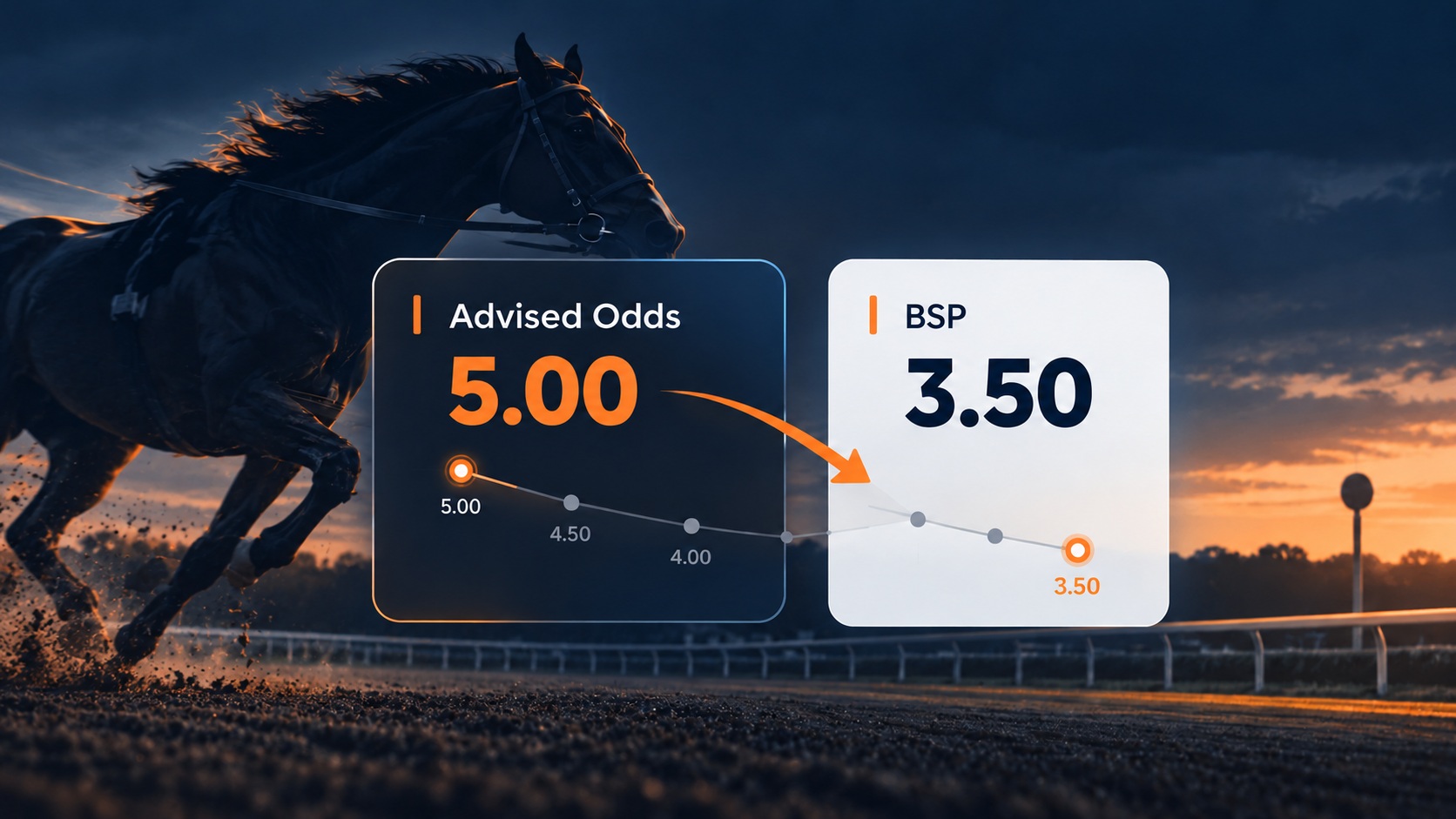
So, if a horse is tipped at 5.00 and that is the price available at the time the bet is published, the result would normally be recorded at 5.00.
BSP, or Betfair Starting Price, is the price calculated by Betfair when the racing market closes at the start of the event.
That means the two figures can be very different.
A horse might be advised at 5.00 in the morning, shorten throughout the day and eventually go off at a BSP of 3.80. Equally, a selection advised at 4.00 could drift and end up with a BSP of 5.50.
That price movement can make a big difference to the profit recorded over hundreds of bets.
Why Advised Odds Can Be Misleading
There’s nothing wrong with recording results at the price a horse racing tipster genuinely advised. In fact, if the odds were widely available when the selection was sent, it makes sense to show them.
The issue is whether followers could realistically get those prices themselves.
Imagine a horse racing tipster sends a horse at 8.00. Within a few minutes, the price falls to 6.00 and most subscribers end up betting somewhere around there, or discarding the selection altogether.
If the official results still record every bet at 8.00, the long-term profit shown on the website could look considerably better than the experience of the average member.
This can become even more noticeable in lower-grade races or with services that have a large following. A single tip can move a price quickly, particularly in smaller betting markets.
That’s why headline profits at advised odds need a little context.
Why BSP Is a Useful Benchmark
BSP gives you something much more consistent to compare against.
It gives you a standard closing price for a horse racing selection, without having to worry about whether a particular bookmaker offered the advised odds for two minutes, ten minutes or half the day.
It also gives you a useful reference point for seeing how the advised price compared with the market at the off.
That makes it particularly useful when comparing the performance of different horse racing services.
The Problem With Using BSP Alone
That doesn’t mean BSP should automatically replace advised odds.
If a horse racing tipster regularly finds good prices several hours before a race, judging everything at BSP could actually understate the results available to followers who act quickly.
Say a service advises a horse at 5.00 in the morning and the price is available across several bookmakers for a reasonable amount of time.
It later shortens to a BSP of 3.50 and wins.
Recording the result at 3.50 would ignore the fact that subscribers genuinely had the opportunity to back it at 5.00.
The real question is whether the advised odds were available for long enough, and widely enough, for followers to get something close to them.
How Much Difference Can Advised Odds Make?
Even fairly small differences in price can add up over time.
Imagine two tipsters make exactly the same 100 selections, with 30 winners.
One records the average winning price at 4.00, while another measures the same selections at 3.50 BSP.
Level stakes at 4.00:
- 30 winners at 4.00 return 90 points
- 70 losers cost 70 points
- Total profit = 20 points
Level stakes at 3.50:
- 30 winners return 75 points
- 70 losers cost 70 points
- Total profit = 5 points
The selections haven’t changed and the strike rate hasn’t changed either. The only difference is the price.
That example is deliberately simple, but it shows why odds availability matters so much when assessing tipster performance.
A few ticks here and there might not look important on individual bets, but over hundreds or thousands of selections, they can make a major difference.
What Beating BSP Tells You About a Tipster
One of the more useful things you can look at is whether a tipster’s advised prices regularly beat BSP.
If a horse is advised at 7.00 and eventually starts at 5.00, the tipster has effectively secured a better price than the closing market.
One example doesn’t tell you much.
Over hundreds of bets, though, consistently beating BSP suggests the tipster may be finding value before the market has fully adjusted.
It still doesn’t guarantee profit. A horse racing tipster can beat BSP regularly and go through losing periods, just as a service can temporarily make money without consistently beating the closing price.
But over a large enough sample, the comparison gives you another useful piece of information beyond simply looking at profit.
Which Results Should You Pay Most Attention To?
Ideally, I want to see both.
Advised odds show the results followers could potentially have achieved if they acted when the bets were sent.
BSP results give you a more consistent benchmark and help show how the selections performed at the market’s closing price.
If a tipster is profitable at advised odds and still profitable at BSP, that is a particularly strong sign. It means the service has not only found better prices earlier in the market, but the selections have still performed well at the closing price.
The important question is whether followers had a realistic chance of getting close to those advised prices. If the early odds disappear almost immediately, the headline profit may be harder to reproduce in practice.
Final Thoughts
Advised odds and BSP both tell you something useful, but they answer slightly different questions.
Advised odds show what was available when the tipster released the selection. BSP gives you a standard closing price that makes it easier to judge the quality of those selections against the wider market.
For me, the most useful results are the ones that show both.
A tipster who records strong profits at advised odds, gives followers a realistic chance to get those prices and regularly beats BSP is giving you much more useful information than a headline profit figure on its own.
The key is transparency. The more detail you can see behind the results, the easier it becomes to judge whether the performance is something you could realistically hope to follow yourself.
This is one of the things worth checking when choosing a betting tipster.